Family game night used to mean a cupboard full of battered boxes with half the pieces missing. It still can, and there is nothing better than a real board on a real table. But a tablet or laptop has a few advantages of its own: nobody has to read the rulebook aloud, the computer keeps score without arguments, and nobody spends ten minutes hunting for a missing die under the sofa.
The best games for mixed ages share a few qualities. The rules can be explained in a minute. Turns are short, so nobody waits long. There is enough luck that a seven-year-old can beat a grandparent, and enough choice that the grandparent stays interested. Here are ten games on MerryArcade that pass that test, with a note on how to play each one as a group.
How to play together on one screen
Our games are built for one person at the controls, usually against a computer opponent. That turns out to work well for families. Here are three ways to share them.
- Team up against the computer. Everyone sits round one screen, discusses each move, and takes turns at the controls. It turns a solo game into a lively group decision.
- Pass the device. Each person plays their own round and the family compares scores. Games with a clear score, like Yatzy or the trivia quiz, are perfect for this.
- Play side by side. Two devices, the same daily puzzle, and a race to finish. Great for older children and competitive grandparents.
1. Daily Word
Guess the hidden five-letter word in six tries, with coloured tiles telling you which letters are right. Because everyone in the world gets the same word each day, it is ideal for comparing at breakfast or in the family group chat. Younger children can help by suggesting letters, while older players work out which guesses use the clues best.
2. Trivia Quiz
Ten questions a round, drawn from geography, history, science, film, music, food, sport, nature and books, with fifteen seconds for each. Faster answers earn more points. This is where generations shine in different categories: grandparents know the history, teenagers know the music, and the whole family argues happily about the rest. Play it as a team, with one person reading questions aloud.
3. Yatzy
The classic five-dice game. Roll up to three times a turn, holding the dice you like, then score in one of thirteen categories, from ones and twos up to full house, straights and the five-of-a-kind Yatzy. Every category must be filled once. It is perfect for passing the device, since each person plays a full scorecard and compares totals. Children practise addition without noticing, and the choice of where to score keeps adults thinking.
4. Ludo
Race your four tokens around the board and home before the computer does. A six releases a token and earns another roll, and landing on a rival sends them back to the start. Ludo has kept families company for generations because it is almost all luck with a sprinkle of decisions, which keeps everyone in with a chance. You can play against one, two or three computer opponents.
5. Snakes and Ladders
The simplest race game of all, and one with deep roots: versions of it were played in India long before it travelled to Britain and beyond. Roll, move, climb the ladders, slide down the snakes. In our version a six earns another roll, and you must land on square 100 exactly. It needs no skill at all, which makes it a perfect first game for very young children and a fine place to practise counting squares out loud.
6. Checkers
A step up in strategy. Pieces move diagonally, captures are compulsory and multiple jumps chain together, and reaching the far row crowns a king. Our version plays standard American rules against a computer with three skill levels. Grandparents who learned on a wooden board will feel right at home, and it is a lovely game to teach a child, starting on Easy and talking through each move together.
7. Four Up
Drop discs into a seven-column grid and be first to line up four in a row, across, down or diagonally. It takes seconds to learn and teaches a real lesson in looking ahead: before you drop a disc, check whether you are setting up your opponent. Three difficulty levels mean the youngest can win on Easy while adults are properly challenged on Hard.
8. Fleet Hunt
The naval guessing duel. Hide your five ships, then take turns firing shots at the enemy grid. A hit tells you to search nearby; sink all five ships before yours go down. It is a great team game, because choosing where to fire next invites discussion, and children quickly learn that searching in a pattern beats random guessing.
9. Dots and Boxes
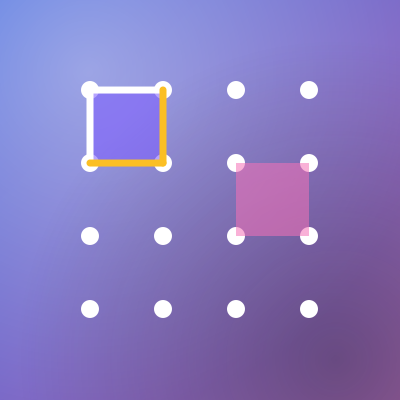
A pencil-and-paper classic. Players take turns drawing a line between two dots; complete the fourth side of a box and you claim it and go again. The subtle part is the endgame, where the player forced to draw the third side of a box hands it to the opponent. Children can play it from the start, and adults can discover the surprisingly deep strategy of controlling who gets stuck. Boards range from four by four to six by six.
10. Dominoes
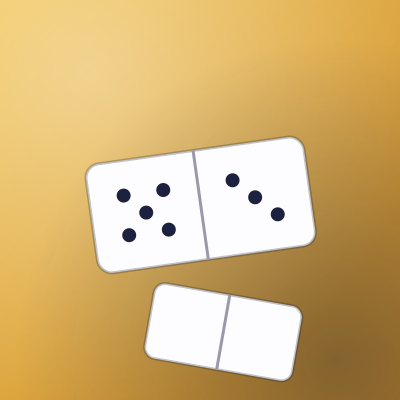
Match the ends of your tiles to the open ends of the line, and be first to play out your hand. If you cannot play, draw from the boneyard. When you go out, the pips left in your opponent’s hand become your score, and the first to 100 wins. Dominoes is a favourite in many families and many countries, and it quietly exercises counting and planning.
Keeping family game night friendly
- Mix luck and skill. Alternate a luck-heavy game like Ludo or Snakes and Ladders with a thinking game like Checkers, so everyone gets a turn to shine.
- Keep rounds short. Several quick games beat one long one, especially with young children.
- Let the youngest choose. Giving the smallest player the first pick makes them feel part of the evening.
- Celebrate good moves, not just wins. "That was a clever block" goes a long way.
- Set a stopping time. End while everyone is still having fun, and they will want to come back next week.
- Put the phones away. The device you are playing on is the exception; everything else can wait.
The point of it all
The game is only ever half of game night. The other half is the conversation, the groans at a bad roll, the cheer when someone finally sinks the last ship. Whether you play on a screen, at a table or both, an hour spent playing together is an hour well spent. Pick two or three games from this list, set aside an evening, and see which becomes your family favourite.